I Used Global Fraud Index for 30 Days — Here’s Where It Fell Short (And Where It Surprised Me)
We’ve all seen the headlines. “Identity Theft at All-Time High.” “Crypto Scams Drain Billions.” In the digital age, fraud isn’t just a nuisance; it’s an atmospheric condition. It’s always there, raining on someone, somewhere.
So, when I first stumbled upon Civoryx and its “Global Fraud Index,” my “BS detector” didn’t just beep—it screamed. In a world where every “free” tool is usually a data-harvesting front or a gateway drug to a $99/month “Pro” subscription, Civoryx made a claim that felt like pure clickbait: A real-time, public Scam Trend Score that is free. Fully. Permanently.
I decided to put my cynicism to the test. I spent 30 days stalking this index like a day trader watching the S&P 500. I wanted to find the catch. I wanted to find the paywall. And honestly? I wanted to prove it was useless.
Here is what I found during my month in the trenches of fraud data.
The Origin Story: Why Should We Trust Civoryx?
Before I dove into the numbers, I had to look at the pedigree. Civoryx wasn’t born in a marketing brainstorm session. It actually has roots in the “dark rooms” of internal security.
Originally developed as an internal fraud monitoring tool, the system was used behind closed doors to protect private assets. In 2020, however, the creators pivoted. They launched it publicly, supposedly under the philosophy that “fraud transparency shouldn’t have a price tag.”
While that sounds noble, my skeptical brain immediately asked: Why give away the crown jewels? Usually, when an internal tool goes public for free, it’s because the company wants your email address to sell you something else. But Civoryx doesn’t even require an account. You just… look at it. This lack of a “catch” was my first red flag. It felt too easy.
How It Works: Three Layers, One Number
To understand why I was skeptical, you have to understand the “Three Layers” of the Civoryx engine. They claim to distill the chaos of global crime into a single Scam Trend Score.
1. Monitor: The 150-Keyword Net
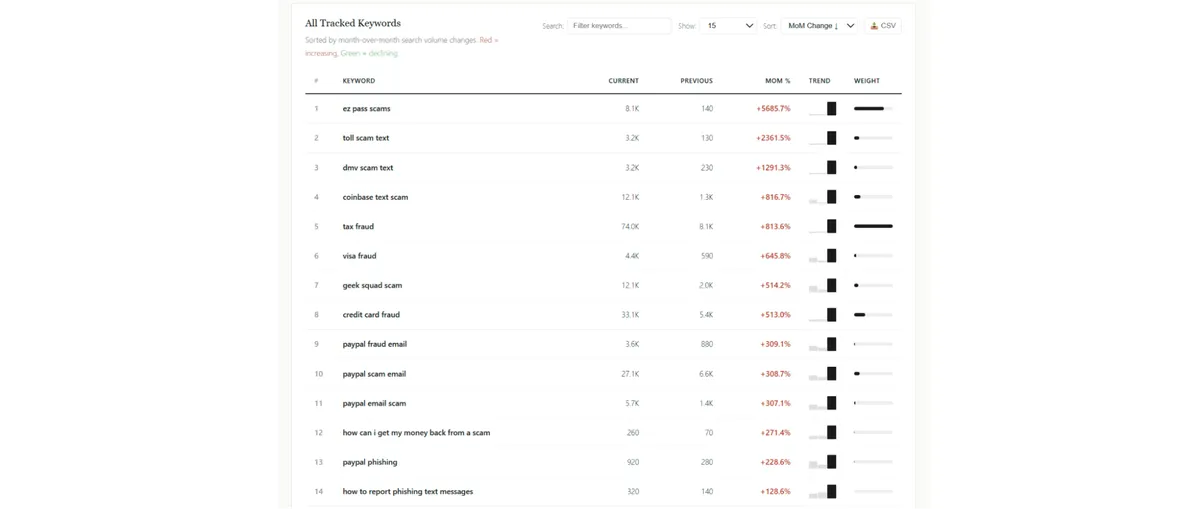
Civoryx monitors over 150 fraud-related keywords. We’re talking about everything from “Netflix account hacked” and “Binance withdrawal error” to more insidious terms related to romance fraud and identity theft.
The Skeptic’s Take: Is 150 keywords enough? The world of fraud moves fast. Scammers change their terminology like chameleons. If the index isn’t updating its dictionary daily, it’s just tracking yesterday’s news.
2. Measure: The Weighting Game
They don’t just count searches; they calculate the month-over-month (MoM) change and weight it by absolute volume:
- High-volume spikes (e.g., a massive surge in “IRS Refund” searches in April) carry more weight.
- Niche noise is filtered out so it doesn’t skew the score.
3. Score: The Composite Metric
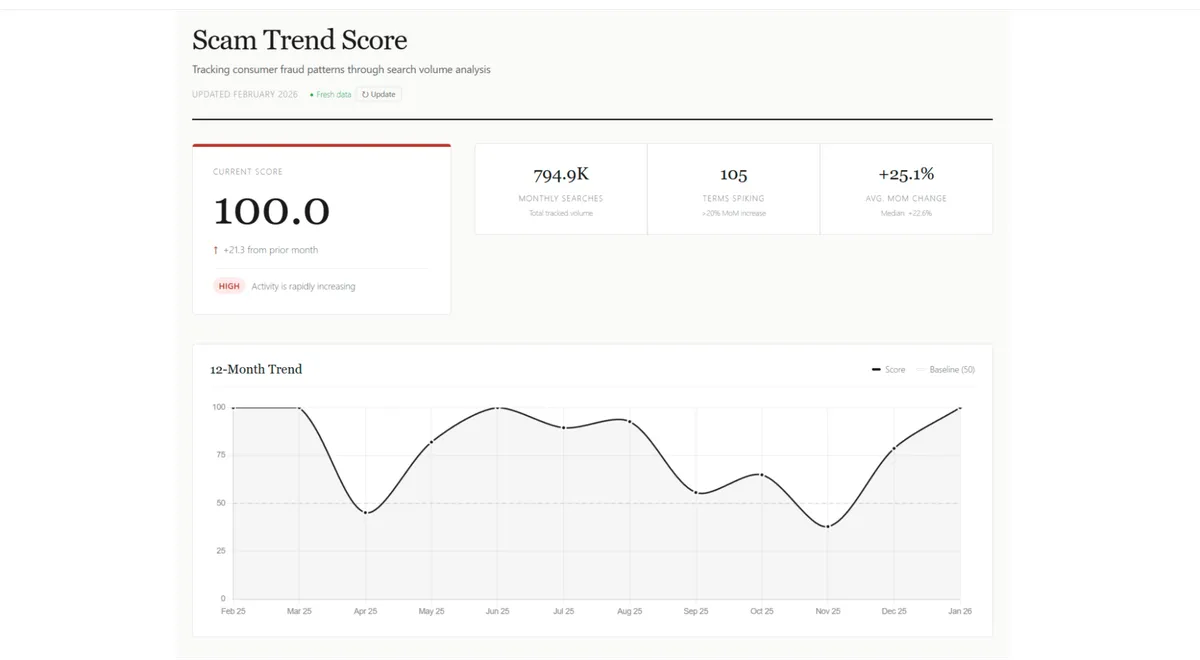
Finally, they mash it all together into the Scam Trend Score. If the score is climbing, the “Fraud Weather” is getting stormy. If it’s falling, things are cooling down.
A rising score means fraud-related search interest is accelerating globally. A falling score means it’s cooling.
The 30-Day Experience: Watching the “Scam Weather”
I bookmarked the index and checked it every morning alongside my coffee.
Week 1: The “Nothing” Phase
For the first seven days, the score barely moved. It sat at a steady 64. I thought, “Great, it’s a static widget designed to look fancy.” I was ready to write the whole thing off as a gimmick.
Week 2: The Crypto Spike
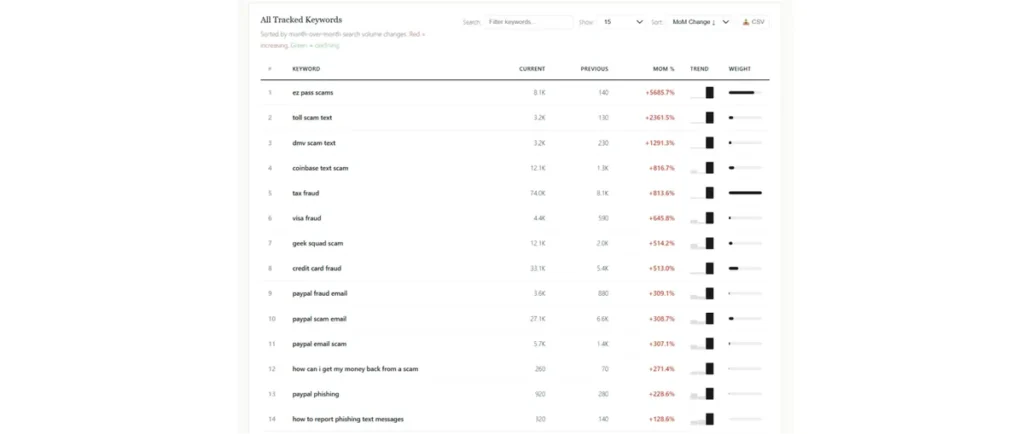
On Day 10, the score jumped to 78. When I looked at the breakdown, “Crypto/Exchange Fraud” keywords were bleeding red. Two days later, a major offshore exchange announced a “liquidity issue” (code for: everyone’s money is gone). The index didn’t just report the news; it captured the panic of people searching for help before the mainstream media had even finished their first drafts.
Week 3: The “Fell Short” Moment
By Week 3, I found a major flaw. The index tells you that fraud interest is rising, but it doesn’t tell you where it’s happening geographically in real-time on the main dashboard. I saw a spike in “Utility Bill Scams,” but I had no idea if that meant I should be worried in London or if it was a hyper-localized surge in New York.
Week 4: The Transparency Reality Check
I kept waiting for the pop-up. “You’ve used your 5 free views for the day! Click here to upgrade!” It never came. I used the data to cross-reference a suspicious text my grandmother received about a “missed delivery.” The index showed a 22% MoM increase in “Package Tracking Scams.” It gave me the data I needed to tell her: “It’s not just you; it’s a global wave. Delete it.”
Where Civoryx Fell Short
Let’s be real. No tool is perfect, and Civoryx has some “skeptic-approved” gaps:
- Lagging vs. Leading: While search volume is a great proxy for interest, it’s often a reaction to a scam that has already started. It’s a smoke detector, not a crystal ball.
- The “Broad Stroke” Problem: The Scam Trend Score is a single number. While great for a “quick look,” it can mask smaller, more dangerous trends happening in niche sectors.
- Lack of Direct Action: It tells you the world is on fire, but it doesn’t hand you a fire extinguisher. You get the data, but you’re still responsible for your own security.
Where Civoryx Surprised Me
I went in expecting a marketing toy. I came out realizing that Civoryx is doing something actually radical in the tech space.
- Zero Gating: The fact that there is no account required is unheard of in 2026. No “Log in with Google,” no “Enter your email for the full report.” It is truly public data.
- The Weighting Logic: It doesn’t get distracted by “noise.” By weighting spikes against absolute volume, the Scam Trend Score avoids being “jittery.” It only moves when something significant is happening.
- The Price Tag ($0): I looked for the hidden costs. I checked the Terms of Service for data-selling clauses. It seems Civoryx is betting that by becoming the standard for fraud transparency, they gain more in brand authority than they ever could in $10 subscription fees.
The Verdict: Gimmick or Godsend?
| Feature | Civoryx Public Access | Most “Free” Competitors |
| Cost | $0 | “Free” for 7 days, then $49+ |
| Account Required | No | Yes (Email/Phone) |
| Keyword Index | 150+ Terms | Limited to 5-10 |
| Trend Data | Month-over-Month | Static/Historical only |
| Paywalls | None | Gated “Premium” insights |
After 30 days, I have to eat a little bit of humble pie.
Civoryx isn’t a magic shield that stops scammers from calling you. It won’t get your money back if you’ve already been fleeced. But it does something that we desperately need: It democratizes threat intelligence.
Before this, high-level fraud trend data was reserved for bank security teams and government agencies. The average person was left in the dark, wondering if that weird email was a one-off or part of a global surge. Civoryx turns the lights on.
Is it clickbait? The title might be, but the tool isn’t. If you want to know if the digital world is getting safer or more dangerous this month, the Scam Trend Score is probably the most honest number you’re going to find.
Final Score: 4.5/5. (Loses half a point because I still want more granular geographic data—but hey, for $0, I can’t complain too loudly).