Civoryx Global Fraud Index Honest Review: Can a Scam Score Dashboard Help You Stay Safe Online?
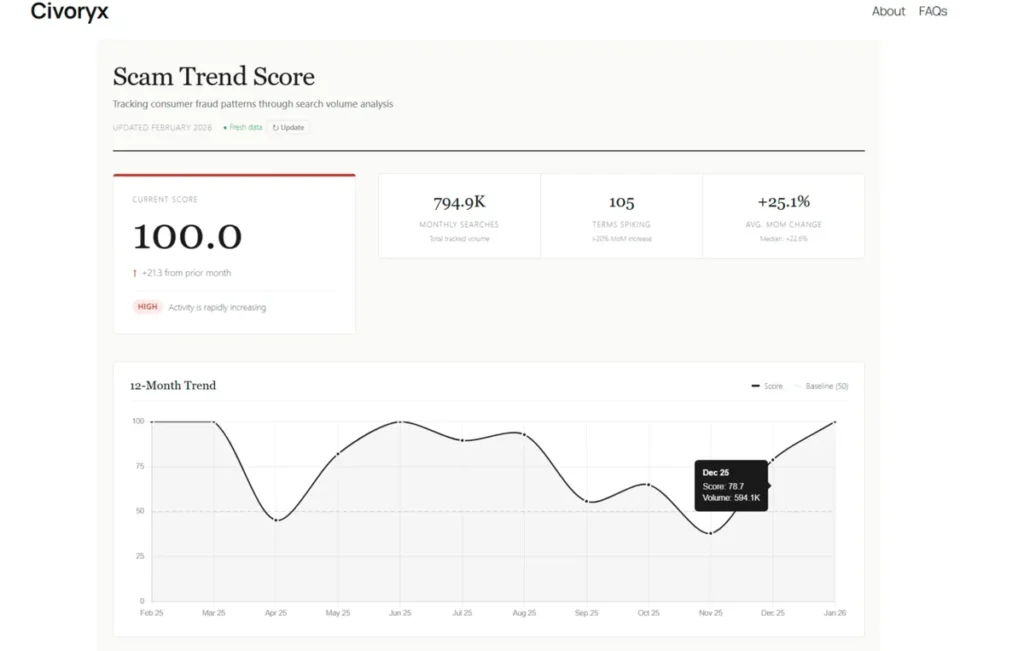
The internet has a speed problem when it comes to fraud. Cybercriminals and scammers are incredibly agile, shifting their tactics, narratives, and attack vectors on a daily basis. By the time a new phishing campaign or impersonation scam makes the evening news or gets a write-up in a major publication, it has usually already peaked and done its damage. For the everyday consumer, relying on the news to stay safe is like looking in the rearview mirror to see what’s ahead of you.
Enter the Civoryx Global Fraud Index!
Civoryx aims to bridge this dangerous gap between when a scam is born and when the public becomes broadly aware of it. Instead of waiting for victims to report losses, Civoryx looks at a real-time, undeniable metric: human curiosity and panic, measured through search data.
In this comprehensive review, we will dissect the Civoryx platform, analyze its unique Scam Trend Score, dive deep into its latest dataset to see what scams are trending right now, and ultimately answer the question: Can a free scam score dashboard actually help you, your family, or your business stay safe online?
The Origin Story: From Internal Tool to Public Utility
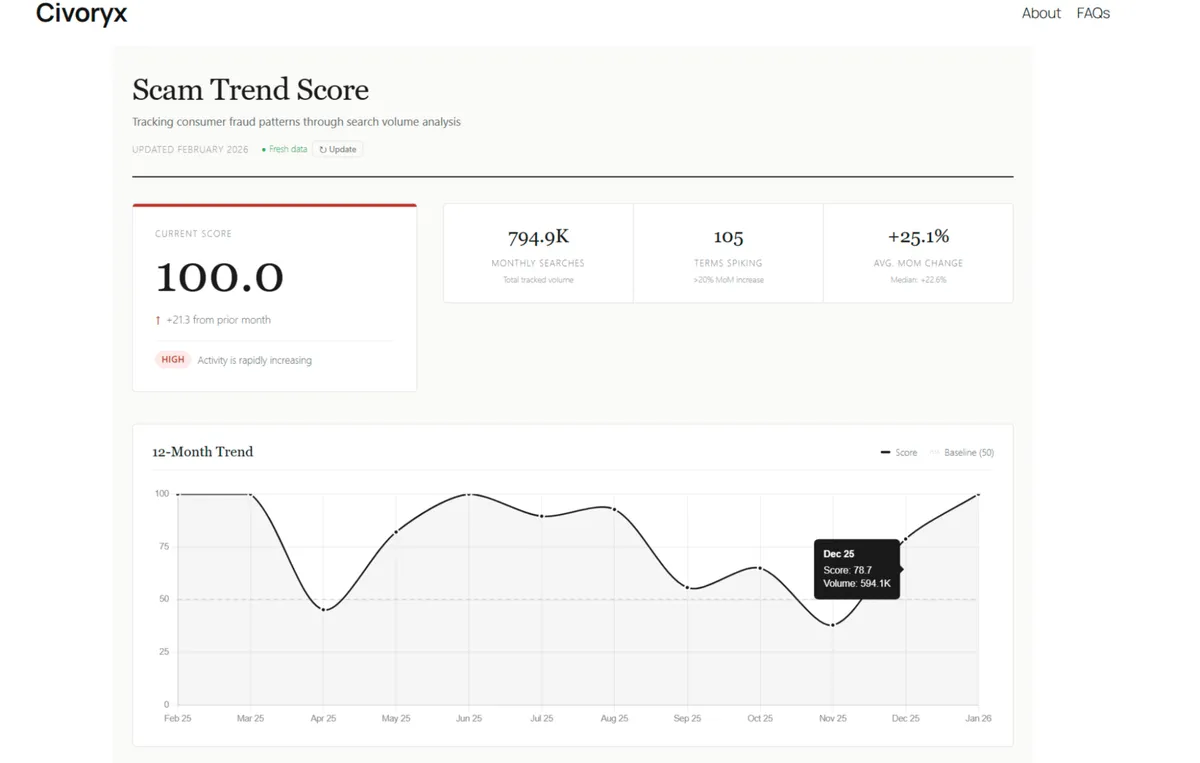
Before diving into the mechanics of the platform, it is crucial to understand its pedigree. Civoryx was originally developed as an internal fraud monitoring tool before launching publicly in 2020. This unique fact explains a lot about the platform’s DNA. It wasn’t built as a flashy consumer app designed to serve ads. It was engineered to solve a distinct problem for fraud analysts: How do we know what scams are gaining traction before the loss reports start rolling in?
When Civoryx opened its doors to the public in 2020, it brought enterprise-grade trend monitoring to the everyday internet user. Its guiding philosophy is starkly refreshing in an internet landscape filled with fear-mongering and clickbait: “No opinions. No speculation. Just data.”
Civoryx exists because fraud evolves faster than headlines can follow. It was built to surface these subtle shifts early, giving researchers, journalists, compliance teams, cybersecurity professionals, and consumers a real-time lens into exactly what the world is searching for when it comes to online deception.
How the Civoryx Algorithm Works: Three Layers, One Score
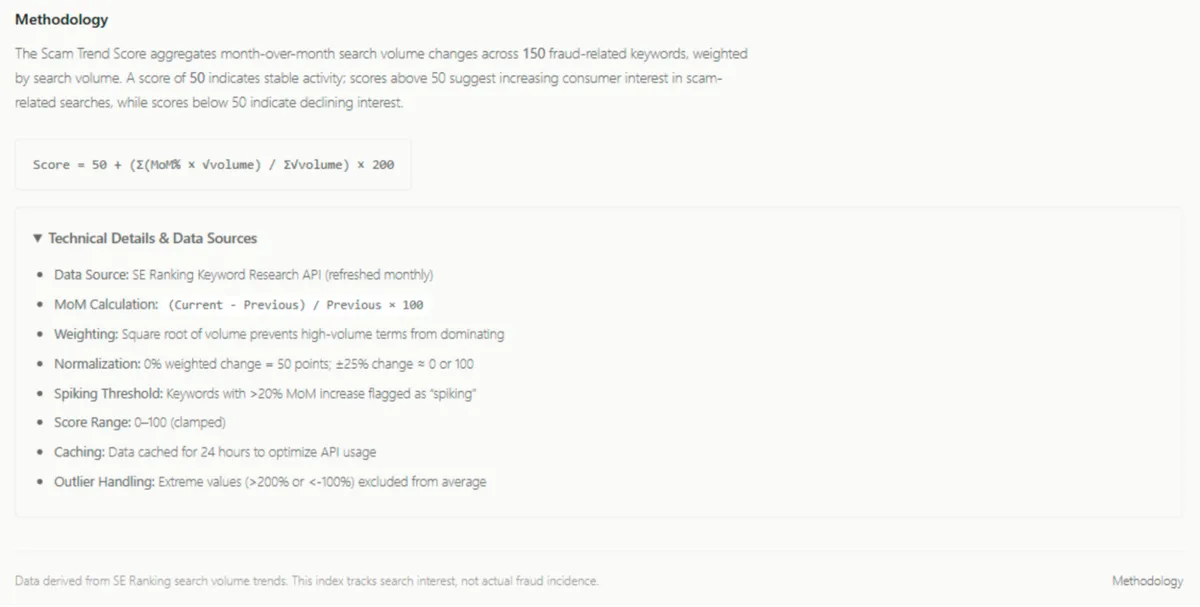
The core of the Civoryx platform is the Scam Trend Score. It is not a subjective rating arbitrarily decided by a panel of experts. Instead, it is an automated, data-driven composite metric.
The dashboard operates on a simple but highly effective three-layer methodology:
1. Monitor
Civoryx maintains a curated index of over 150 specific, fraud-related search terms. This isn’t just a random assortment of words; it spans distinct categories like phishing, identity theft, cryptocurrency scams, romance fraud, government impersonation, and more. By continuously tracking the global search volume for these specific keywords, the platform keeps a constant pulse on user concern.
2. Measure
Raw search volume is not enough to indicate a new threat. If a million people search for “credit card fraud,” it might just be background noise. To find the signal in the noise, Civoryx calculates the month-over-month (MoM) change for each keyword. Crucially, they weight this velocity by the keyword’s absolute search volume.
Why does this matter? A high-volume keyword that suddenly spikes by 20% carries a massive signal indicating a widespread campaign. A highly niche, obscure term that spikes by 100% might just be statistical noise. Weighting the data ensures the most impactful threats rise to the top.
3. Score
These weighted, month-over-month changes are then aggregated into a single, easy-to-read composite metric: the Scam Trend Score. So:
- A Rising Score means that fraud-related search interest is accelerating globally. Cybercriminals are launching fresh campaigns, and internet users are running to search engines to figure out if the text or email they just received is legitimate.
- A Falling Score means the environment is cooling down. Old campaigns are fading, and new ones haven’t yet taken their place.
This score is updated regularly and displayed publicly on their index. There are no accounts required, no paywalls, and no gating. You simply load the dashboard and immediately see the current temperature of global fraud.
Diving into the Data: What is Trending Right Now?
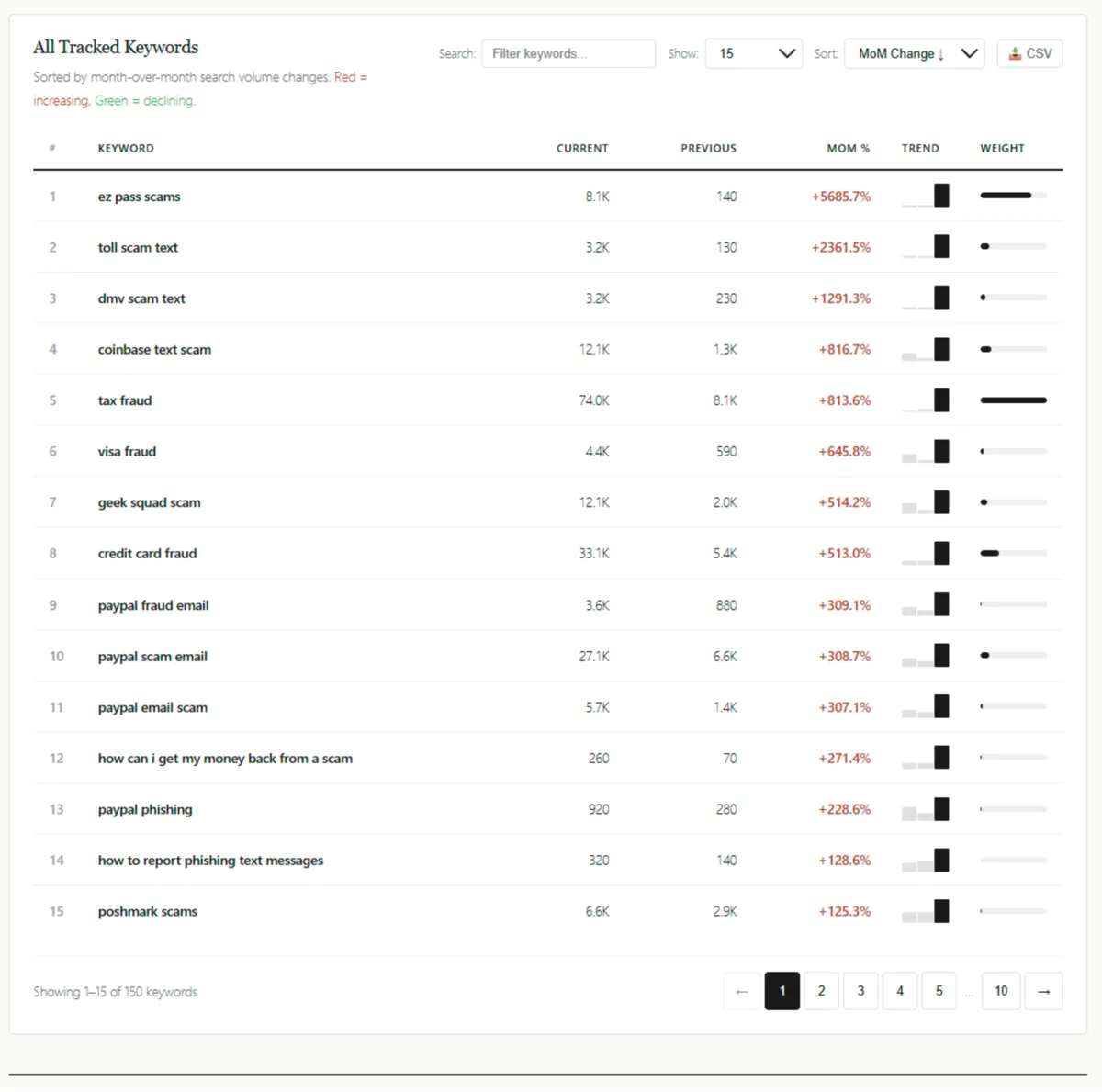
To truly understand the value of Civoryx, we have to look at the data it produces. An analysis of the latest keyword dataset highlights a highly concentrated signal. Right now, a very small cluster of scam themes is driving almost all the movement in the index.
Here are the top contributors to the current Scam Trend Score, ranked by their weighted impact:
- tax fraud — Contribution: 75.74
- ez pass scams — Contribution: 57.94
- credit card fraud — Contribution: 21.36
- coinbase text scam — Contribution: 12.43
- paypal scam email — Contribution: 10.53
- toll scam text — Contribution: 9.51
- geek squad scam — Contribution: 7.83
- dmv scam text — Contribution: 5.20
- visa fraud — Contribution: 3.57
- paypal email scam — Contribution: 2.20
From a risk and compliance perspective, this concentration is incredibly telling. The data clearly indicates that seasonal financial fraud (tax season) and localized impersonation campaigns (toll roads) are currently exerting the strongest influence on global fraud attention.
The massive spike in tax fraud (75.74 contribution) is a classic seasonal indicator. As tax season approaches, scammers ramp up their IRS impersonation calls, fake tax return emails, and malicious tax preparation services.
However, the second highest contributor, EZ Pass scams (57.94), points to something more insidious: a massive surge in infrastructure smishing (SMS phishing). Scammers are blanketing phones with text messages claiming the user owes a minor toll fee, providing a link to a fake government payment portal designed to steal credit card details.
The Fastest-Growing Scams: The Shift to Smishing
While the top contributors show absolute impact, looking at the fastest-growing scam themes reveals where cybercriminals are pivoting their resources. The Civoryx dataset shows unusually sharp month-over-month growth in several infrastructure and payment-related scams:
- ez pass scams — +5,685%
- toll scam text — +2,361%
- dmv scam text — +1,291%
- coinbase text scam — +817%
- tax fraud — +814%
- visa fraud — +646%
- geek squad scam — +514%
- credit card fraud — +513%
If you look closely at these numbers, a distinct narrative emerges: The clear channel shift toward SMS-driven impersonation. “EZ pass scams,” “toll scam text,” “dmv scam text,” and “coinbase text scam” all rely on sending malicious text messages directly to a user’s phone. Why are scammers abandoning email for text? Because text messages feel more immediate and urgent.
When you get an email from the “DMV,” it might sit in your spam folder for days. When your phone buzzes with a text saying your driver’s license will be suspended in 24 hours if you don’t click a link, human psychology takes over. Panic induces clicks. Civoryx is capturing this exact psychological phenomenon in real-time. Millions of people are receiving these texts, pausing, and Googling “toll scam text” or “coinbase text scam” to verify.
For compliance teams at banks and telecom companies, this specific pattern is a goldmine. It allows them to reassess customer-communication controls and adjust alerting thresholds to protect users from SMS-based payment fraud.
The Decline of Generic Queries: The Narrative-Driven Fraud Cycle
Perhaps one of the most fascinating insights Civoryx provides is what people are stopping searching for. Not all fraud categories are rising. In fact, searches for broader, more generic queries have plummeted:
- is this a scam — Down 55%
- gift card scam — Down 46%
- mcafee scam — Down 45%
- brushing scam — Down 19%
- phishing — Down 18%
Why is this happening? This divergence—where highly specific scam types (like “EZ pass text”) are rising astronomically while generic queries (like “is this a scam”) fall—signals what fraud analysts call a narrative-driven fraud cycle.
Public attention is no longer focused on broad cybersecurity concepts. The threats have become so targeted and so specific that users are searching for the exact wording of the malicious text they received. Prominent, highly visible threats dominate the public consciousness, pushing older, generic threats out of the way. Scammers know this, which is why they constantly rotate their narratives from “McAfee renewals” to “EZ Pass tolls.”
Category Structure: A Macro View of the Signal
Grouping the 150 keywords by intent helps break down the composition of the current index. This structural view is vital for understanding the macro landscape of internet fraud:
- Tax-related fraud: The single largest driver, contributing approximately 75.7 to the overall score.
- Payments & financial scams: The second largest, with roughly a 56 contribution across credit card and digital wallet fraud.
- Messaging vectors (SMS/email/calls): Contributing roughly 15.6, reflecting the high risk currently associated with delivery channels (specifically texts).
- Phishing (generic): Sitting at a relatively stable 4 contribution.
- Reporting/prevention queries: The lowest growth sector, contributing only about 1.7 to the score.
This profile underscores Civoryx’s main strength: rapid visibility into exactly where fraud attention is concentrating right now.
Who is Civoryx Actually For?
Because Civoryx was born as an internal enterprise tool, it possesses a level of analytical rigor that appeals to professionals. However, its public availability makes it a versatile tool for several distinct groups:
1. Risk and Compliance Professionals
For enterprise fraud teams, banks, and cybersecurity firms, Civoryx acts as a powerful early warning system. These professionals use the data for:
- Short-term threat briefings: Updating teams on what scams are spiking this week.
- Customer warning campaigns: If a bank sees “coinbase text scam” spiking by 817%, they can preemptively push an alert to their banking app warning users not to click crypto-related SMS links.
- Prioritization of transaction monitoring rules: Adjusting internal security algorithms to flag transactions that fit the profile of trending scams.
- Context for board-level risk reporting: Providing executives with undeniable, data-backed proof of shifting threat landscapes.
2. Journalists and Researchers
Fraud evolves too quickly for traditional research methods. Journalists covering the cybersecurity beat can use the Civoryx Scam Trend Score to identify breaking stories. Instead of writing a retrospective piece on last year’s scams, they can report on the 1,200% spike in DMV text scams happening today.
3. Everyday Consumers
While the terminology might seem geared toward professionals, the everyday internet user is arguably the biggest beneficiary. If you receive a strange text message about a toll fee or a panicked email about your PayPal account, a quick glance at the Civoryx dashboard will likely confirm that thousands of other people are searching for the exact same thing. It provides immediate, data-backed peace of mind and prevents you from becoming a victim.
Pricing: The Philosophy of Open Data
In an industry where threat intelligence feeds can cost enterprise companies tens of thousands of dollars a year, Civoryx’s pricing model is radical.
As the creators state: “We believe fraud transparency shouldn’t have a price tag. The data is open because the problem is universal.”
Civoryx is a purely public index:
- No paid tiers.
- No premium plans.
- No gated features.
- No account required.
You get the Scam Trend Score, the 150 keyword index, and the month-over-month trend data for a total cost of $0. This democratization of threat intelligence is arguably the platform’s greatest feature. It levels the playing field, giving a local credit union or a retired school teacher the exact same visibility into global fraud trends as a massive multinational bank.
The Catch: Understanding the Limitations of Search Data
No tool is perfect, and a transparent review must address limitations. The most critical thing to understand about the Civoryx Global Fraud Index is what it doesn’t measure.
The Scam Trend Score measures attention momentum, not confirmed incident volume.
It is a reflection of human curiosity and concern, driven by Google searches. If a massive, silent, backend data breach occurs where hackers steal millions of credit cards without sending a single phishing text, the Civoryx score will not spike—because everyday users aren’t searching for it yet.
Conversely, a scammer might blast out 10 million incredibly obvious, poorly spelled SMS messages. Even if nobody actually falls for the scam or loses money, the sheer volume of confused people searching “is this text a scam” will cause the Civoryx score to skyrocket.
Therefore, most organizations and savvy users treat Civoryx as a leading context indicator. It tells you what bait the scammers are currently throwing into the water. To get a complete risk picture, enterprises must pair this search data with their internal case data, regulatory alerts, and actual financial loss metrics.
Final Verdict: Should You Use Civoryx?
Absolutely!
In a digital world where scams are becoming increasingly sophisticated, automated, and relentless, ignorance is your greatest liability. Civoryx takes the guesswork out of the equation. By transforming the collective searches of millions of internet users into a single, readable dashboard, it provides a real-time weather report for internet safety.
Whether you are a compliance officer looking to tune your transaction monitoring rules, or just someone trying to figure out if that text from the “DMV” is real, Civoryx offers unparalleled, data-driven clarity. It strips away the panic, ignores the speculation, and leaves you with the one thing that actually matters when fighting fraud: the truth, backed by data.
And because it is entirely free and accessible to the public, there is simply no reason not to bookmark the dashboard and check it regularly.
FAQ
What exactly is the Civoryx Global Fraud Index?
Civoryx is a real-time tracking dashboard that monitors how internet search attention shifts around fraud and scams. Originally built as an internal tool for fraud analysts, it tracks over 150 scam-related keywords to detect which malicious campaigns are gaining traction before they hit mainstream news.
How is the Scam Trend Score calculated?
The score is a data-driven composite metric built on three steps:
- Monitor: It tracks the global search volume for 150+ specific fraud keywords.
- Measure: It calculates the month-over-month (MoM) growth of these searches, weighting them by their total volume so niche terms don’t skew the data.
- Score: It aggregates these weighted changes into a single number. A rising score means fraud searches are accelerating; a falling score means they are cooling down.
Is Civoryx really free? What’s the catch?
Yes, it is completely free. There are no paid tiers, premium plans, gated features, or account requirements. The creators built it on the philosophy that “fraud transparency shouldn’t have a price tag” because the problem affects everyone.
What types of scams are trending the fastest right now?
According to recent data, there is a massive shift toward SMS-driven impersonation (smishing). The fastest-growing threats include text messages pretending to be from toll road services (like EZ Pass), the DMV, and crypto platforms like Coinbase. Scammers are using the urgency of text messages to force quick, panicked clicks.
Does a rising Scam Trend Score mean more people are losing money?
Not necessarily. This is a crucial distinction: Civoryx measures attention momentum, not confirmed financial losses. If millions of people receive an obvious scam text and search Google to see if it’s fake, the score will skyrocket even if no one actually loses a dime. It is an early warning system for attempted fraud campaigns, not a ledger of stolen funds.
Why are searches for things like “is this a scam” or “phishing” going down?
Broad, generic searches are declining because scams have become highly specific and narrative-driven. Instead of wondering about general cybersecurity, users are searching for the exact wording of the fraudulent text or email they just received (e.g., “EZ pass toll text”).
Who should be using this dashboard?
Civoryx is designed for a wide range of users:
- Consumers: To check if a suspicious text, call, or email is part of a broader, trending scam campaign.
- Risk & Compliance Teams: To adjust transaction monitoring rules and preemptively warn customers about emerging threats.
- Journalists & Researchers: To report on the real-time reality of cybercrime rather than relying on delayed historical data.